Monday, March 7, 2011

Chapter 14 - Origin of Species

Q: What is the difference between micro and macroevoltuion?
A: Microevoltuion is the changes in a singel gene pool where as macroevoltion deals with patterns of evolutionary change over long periods of time.
Q: What is a species?
A: A species is a kind of organism.
Q: How does environment affect evolution?
A: Evolution is affected by environment because in some cases a population may be secluded from outside contact.

Five main facts:
1) Reproductive barriers keep species separate.
2) In allopatric speciation, geographic isolation leads to speciation.
3) Reproductive barriers may evolve as a population diverges.
4) Most plant species trace their origin to polyploid speciation.
5) Hybrid sones provide opportunities to study reproductive isolation.

This diagram shows polyploid speciation. Polyploid speciation is where organisms with more then two sets of homologuous chromosomes are able to breed.

Chapter 14 focuses on how species have evolved over time. This is partially due to natural selection but other variables are present. Speciation allows for new species to diversify. Reproductive barriers have also lead to a very diverse set of species because only certain organisms are able to breed together. Environment also affects how species have evolved over time. 

Key Terms:
1) Taxonomy: branch of biolgy that names and classifies species
2) biological species concept: primary definition for species
3) Reproductive isolation: prevents genetic exchange and maintains the gap between species
4) Reproductive barrier: biological feature of the organism itself
5) Prezygotic barriers: prevent mating or fertilization between species
6) Postzygotic barriers: operate after hybrid zygotes are formed
7) Allopatric speciation: initial block of gene flow due to geographic barrier
8) Sympatric speciation: new speices that arise within the same geographic area as a parent species
9) Polyploid: cells have more then two complete sets of chromosomes
10) Adaptive radiation: evolution of many diverse species from a common ancestor 

http://www.youtube.com/watch?v=YCoEiLOV8jc

Chapter 13 - How Populations Evolve

Q: What is Darwins theory of evolution?
A: He felt that evolution was by means of descent with modification.
Q: What is natural selection?
A: A natural process that results from evolution for those best suited for their environment.
Q: What is homology?
A: Homology is the similarities in different species due to evolution from a common ancestor.

Five main facts:
1) Darwin theorized evolution.
2) Scientists are able to observe natural selection while it is in action.
3) Fossils provide strong evidence for evolution.
4) Homologies indicate patterns of descent that can be shown on an evolutionary tree.
5) Sexual selection can lead to phenotypic differences between males and females.

This diagram shows a stabilizing selection. This favors intermediate phenotypes. 

This chapter talks about evolution and how it came about. Darwin is the father of evolution and he came about this theory when he traveled to the Galapagos Islands. Adaptations of species allows for them to be better suited for their environment. Natural selection plays a major role in evolution. Populations are said to evolve and Hardy-Weinberg showed this through his theory of equilibrium.

Key Terms:
1) Artificial selection: modified species by selecting and breeding individuals to possess desired traits
2) Natural selection: natural process that results from evolution for those best suited for their environment
3) Extinction: when a species no longer exists
4) Paleontologists: scientists who study fossils
5) Fossil record: sequence in which fossils appear within layers of sedimentary rock
6) Strata: layers of rock
7) Homology: similarity in characteristics that results from common ancestory
8) Vestigial organs: structures that are of marginal or perhaps no importance to an organism
9) Evolutionary tree: patterns of descent in evoltuion
10) Mutation: change in the nucleotide sequence of DNA

http://www.youtube.com/watch?v=vss1VKN2rf8

Chapter 12 - DNA Technology and Genomics

Q: Why does the rapid reproduction of bacteria make them suitable choices for cloning foreign genes?
A: They are suitable because they are located within plasmid DNA which can be replicated each time the cell divides which results in man copies of the same gene.
Q: What are "sticky ends"?
A: These are single-stranded regions with unpaired bases that can hydrogen-bond to the complementary sticky ends of fragments made by restriction enzymes.
Q: What is DNA profiling?
A: This the analysis of DNA fragments to determine whether they come from a particular individual or not.

Five main facts:
1) Enzymes are used to essentially "cut and paste" DNA.
2) Cloned genes are able to be stored in a genomic library.
3) Nucleic acid probes help identify clones carrying certain genes.
4) The PCR method is used to amplify DNA sequences.
5) DNA profiling has aided in many investigations by use of forensics.

This depicts the PCR method. This method is used when the source of DNA is scanty or impure. IT allows for a specific gene segment to be targeted and amplified. 

This chapter focuses on DNA technology. There are several ways in which this is applied. One is through the research on cloning. Other ways include genetically modified organisms, for example the corn many of us eat. It had been modified genetically to be more resistant to certain diseases and to produce more corn itself. DNA profiling has aided in many forensic cases.

Key Terms:
1) Plasmids: small, circular DNA molecules that replicate separately from the much larger bacterial chromosome
2) Gene cloning: production of multiple identical copes of a gene-carrying piece of DNA
3) Genetic engineering: branch of biotechnology that involves the direct manipulation of genes for practical purposes
4) Vector: gene carrier
5) Clone: group of identical cells descended from a single ancestral cell
6) Genomic library: entire collection of all the cloned DNA fragments from a genome
7) Nucleic acid probe: complementary molecule
8) Vaccine: harmless variant or derivative of a pathogen that is used to stimulate the immune system to mount a defense against that pathogen
9) Gene therapy: alteration of an afflicted individual's genes
10) Primers: short, chemically synthesized single-stranded DNA molecules with sequences that are complementary to one strand at one end of the target sequence

http://www.youtube.com/watch?v=eEcy9k_KsDI

Chapter 11 - How Genes are Controlled

Q: How is it that densely packed DNA prevents gene expression?
A: RNA polymerase and other proteins necessary for transcription do not have viable access to DNA that is tightly packed.
Q: How is alternative RNA splicing used to enable a single gene that will encode more than one kind of polypeptide?
A: A polypeptide is encoded by a mRNA molecule that contains different combinations of exons.
Q: What can be learned from a DNA microarray?
A: In a DNA microarray it can be inferred what genes are active in a particular sample of cells.

Five main facts:
1) Proteins that interact with DNA turn prokaryotic genes on or off in response to outside changes such as environment.
2) Differentiation can result from the expression of many combinations of genes.
3) DNA packing in eukaryotic cells help regulate how genes will be expressed.
4) Eukaryotic RNA can be spliced in several different ways.
5) In the later stages of translation, gene expression may be subject to regulation.

This diagram shows the packing of DNA into a chromosome. It shows how spacers are used to keep genes from interfering with one another. 

In chapter 11 the main focus is how genes are expressed. There is a control in both prokaryotic and eukaryotic cells. This allows for certain genes to be expressed that will benefit an organism. Also the cloning fo plants and animals is talked about and can be regulated by scientists through differentiated cells and nuclear transcription. 

Key Terms:
1) Differentiation: when cells become specialized in structure and function
2) Histones: association of the DNA with small proteins
3) Barr body: the inactive X in each cell of a female condenses into this compact object
4) Transcription factors: assistance given from proteins in order for eukaryotic RNA to function
5) Enhancers: binding of activator proteins to DNA sequences 
6) Silencers: proteins that may bind to DNA sequences and inhibit the start of transcription
7) RNA interface: procedure in which researchers can take advantage of miRNA mechanisms to artificially control gene expression
8) Hometic gene: master control gene that regulates batteries of other genes that actually determine the anatomy of parts of the body
9) DNA microarray: glass slide with thousands of different kinds of single-stranded DNA fragments fixed to it in a tightly spaced array or grid
10) Adult stem cells: cells that are able to give rise to many but not all cell types in an organism 

http://www.youtube.com/watch?v=mUcE1Y_bOQE

Chapter 10 - Molecular Biology of the Gene

Q: What does a DNA polymerase do in the process of DNA replication?
A: DNA polymerase is used to line up new nucleotides on the already existing strand in terms of the base-pairing rules.
Q: What do transcription and translation do?
A: Transcription is where information is transfered from DNA to RNA and translation is where RNA is used to aid in the process of making a new protein.
Q: What is a promotoer?
A: A promoter is a certain nucleotide sequence of bases that starts off a strand of DNA.

Five main facts:
1) Transcription produces genetic messages in the form of RNA.
2) Ribosomes are what aid in the building up of polypeptides.
3) There are certain codons that initiate as well as marks the start of an mRNA message.
4) Mutations change genes.
5) A virus may use a host cell so that it may implement its own DNA into that of the host's cell DNA.

This is a model of mRNA. As you can see there is only one side of the helix. Also note that instead of T, in place there is instead U. This is an easy way to tell whether or not it is a normal DNA strand or and that of RNA.

This chapter focuses on how DNA, RNA is used in the cell. DNA holds genetic coding that allows for genes to be passed on through the process of DNA replication. RNA comes into play during the actual DNA replication process. DNA controls both phenotype as well as genotype. All living organisms are able to replicate their genes and even viruses are able to put their DNA into a host cell so that more of that virus may be made. 

Key Terms:
1) Molecular biology: study of DNA and how it serves as the chemical basis of heredity
2) Bacteriophages: a type of bacterial virus
3) Polynucleotides: a type of polymer that is in DNA
4) Double helix: two strands that make up the structure of DNA
5) DNA polymerase: enzymes that link DNA nucleotides to a growing daughter strand
6) DNA ligase: enzyme that links two polynucleotides together to form a single strand of DNA
7) Transcription: transfer of genetic information from DNA to RNA
8) Translation: transfer of information from RNA into a protein
9) Triplet code: flow of information from genes to proteins
10) Codons: genetic instructions for amino acid sequence of a polypeptide chain 

http://www.youtube.com/watch?v=TfYf_rPWUdY

Monday, December 13, 2010

Chapter 9 - Patterns of Inheritance

Q: What is cross-fertilization?
A: This is a process of taking two plants with different traits and crossing the pollen of the two plants with one another.
Q: What is Mendel's law of segregation?
A: When sperm and egg unite at fertilization, each contributes its allele, restoring the paired condition in the offspring.
Q: What do homologous chromosomes do?
A: Homologous chromosomes bear the alleles for each characteristic of the new organism.

Five Main Facts:
1)Genetics use the testcross to determine unknown genotypes.
2) The law of independent assortment is revealed by tracking two characters at once.
3) Mendel's law reflect the rules of probability.
4) Genetic traits in humans can be tracked through family pedigrees.
5) Many genes have more than two alleles in the population.

This is a Mendel chart. This shows the possible phenotypes of the offspring due to the genotype of the parent plants.

Chapter nine focused on genetics. This includes genotype and phenotypes. Mendel studied genetics thoroughly and formulated many useful concepts of genetics. Human genetics follow Mendel's laws. 

Key Terms:
1) Rule of addition: probability that an event can occur in two or more alternative ways is the sum of the separate probabilities of the different ways
2) Pedigree: family tree
3) Carriers: possession of the recessive allele for the disorder but are phenotypically normal
4) Inbreeding: mating of close relatives
5) Amniocentesis: procedure performed between weeks 14 and 20 of pregnancy for fetal testing
6) Complete dominance: dominant allele had the same phenotypic effect whether present in one or two copies
7) Pleiotrophy: influence of multiple characters
8) Polygenic inheritance: additive effects of two or more genes on a single phenotypic character
9) Sex-linked gene: a gene located on either sex chromosome 
10) Hemophilia: a sex-linked gene recessive trait that results in excessive bleeding

http://www.youtube.com/watch?v=X9Qrm6o4tNQ

Chapter 8 - The Cellular Basis of Reproduction and Inheritance

Q: Where do cells come from?
A: Cells are made from preexisting cells through the process of cell division.
Q: How do prokaryotic cells reproduce?
A: Prokaryotic cells reproduce by a type of cell division called binary fission.
Q: What are the three cellular cycles called?
A: G1, S, and G2 and mitosis are the four stages of a cell.

Five Main Facts:
1) All cells come from preexisting cells.
2) Interphase is where the majority of a cells life is spent.
3) Sister chromatids contain identical copies of DNA.
4) Mitosis consists of prophase, prometaphase, metaphase, anaphase and telophase.
5) Anchorage, cell density and chemical growth factors affect the division of a cell.

This diagram shows metaphase. As you can see, the chromosomes are lining up on the metaphase plate so they will be able to be separated by the spindle fibers from the centrosome. 

Cell division is the basis for the reproduction of cells. Chromosomes are duplicated in order to make identical daughter cells. Cells are split into daughter cells through the process called mitosis. Meiosis is the production of sex cells. Four haploid cells are made from this process.

Key Terms:
1) Chromatin: combination of DNA and protein molecules
2) Centromere: two chromatids are joined together tightly at a narrow "waist"
3) Cell cycle: ordered sequence of events that extends from the time a cell is first formed from a dividing parent cell
4) Centrosomes: clouds of cytoplasmic material that in animal cell contain centrioles
5) Cleavage furrow: shallow groove in the cell surface
6) Cell plate: vesicles fuse to form a membranous plate
7) Growth factor: protein secreted by certain body cells that stimulate other cells to divide
8) Anchorage dependence: most animal cells must be in contact with a solid surface
9) Tumor: abnormally growing mass of body cells
10) Diploid cell: any cell with two homologous sets of chromosomes
http://www.youtube.com/watch?v=3kpR5RSJ7SA

Chapter 7 - Photosynthesis: Using Light to Make Food

Q: What is photosynthesis?
A: Photosynthesis is a process that converts light energy into glucose for energy the cell can use.
Q: What are the reactants of photosynthesis?
A: There are two reactants of photosynthesis, carbon dioxide, water, and light energy.
Q: What are the two stages of photosynthesis and how are they connected?
A: Light reactions and the Calvin Cycle are the two stages of photosynthesis and they are linked by ATP and NADPH.

Five Main Facts:
1) 6CO2 + 6H2O+ Light energy ---> C6H12O6+ 6O2
2) Photosystems are certain wavelengths of visible light, absorbed by pigments such as chlorophyll and carotenoids.
3) There are two stages of photosynthesis, light reactions and the Calvin Cycle.
4) ATP and NADPH power sugar synthesis in the Calvin Cycle.
5) Chemiosmosis powers ATP synthesis in the light reactions.

This is a diagram of an electron transport chain with provides energy for synthesis of ATP by chemiosmosis.

Photosynthesis uses light energy to create ATP. There are two stages of photosynthesis, light reactions and the Calvin Cycle. Photosystems make it able for light to be absorbed by pigments. This starts the chemical reaction. The Calvin Cycle converts CO2 into sugars. 

Key Terms:
1) Photosynthesis: chemical reaction in which light is converted into ATP
2) Autotrophs: plants are considered this because they are able to make their own food and sustain themselves
3) Producers: plants that make their own organic molecules and are the ultimate source of organic molecules for almost all other organisms
4) Chlorophyll: light absorbing pigment in the chloroplasts that plays a central role in converting solar energy to chemical energy
5) Mesophyll: green tissue in the interior of the leaf
6) Stomata: tiny pores in the leaf
7) Stroma: thick fluid that fills chloroplasts
8) Thylakoids: system of interconnected membranous sacs
9) Grana: concentrated stacks of thylakoids
10) Carbon fixation: incorporation  of carbon from CO2 into organic compounds

http://www.youtube.com/watch?v=hj_WKgnL6MI

Chapter 6 - How Cells Harvest Energy

Q: What is used in cells in order to harvest energy?
A: A cell uses sugar and air in order to convert it into a viable energy source for the cell.
Q: How are photosynthesis and cellular respiration different?
A: Photosynthesis uses light energy to convert into chemical energy whereas cellular respiration uses air and other reactants in order to create chemical energy.
Q: How many stages are there in cellular respiration?
A: There are three main stages in cellular respiration, glycolysis, citric acid cycle and oxidative phosphorylation.

Five Main Facts:
1) Glycolysis begins respiration by breaking glucose into two molecules of a three-carbon compound called pyruvate.
2) Cells create ATP in order to have energy for the cell to use.
3) When we breathe we are supplying all of our cells with oxygen in order to use for cellular respiration.
4) A concentration gradient is needed for cellular respiration to take place.
5) Fermentation allows for cells to produce ATP without oxygen.

This diagram shows the reactants, products and cycles that a cell goes through during cellular respiration.

Chapter six goes through how cells are able to produce energy to use for cellular function. Photosynthesis and cellular respiration are two ways energy is used. ATP is what these processes create. ATP is the main source of energy for a cell. In order for this process to take place, there must be a concentration gradient of hydrogen otherwise ATP synthase will not be able to take place. 

Key Terms:
1) Cellular respiration: the aerobic harvesting of energy from sugar by muscle cells
2) Redox reaction: movement of electrons from one molecule to another is an oxidation-reduction reaction
3) Oxidation: loss of electrons from one substance
4) Reduction: addition of electrons to another substance
5) Electron transport chain: NADH delivering electrons to the rest of the staircase.
6) Glycolysis: occurs in the cytoplasmic fluid of the cell
7) Citric acid cycle: takes place within the mitochondria
8) Oxidative phosphorylation: involves the electron transport chain and a process known as chemiosmosis
9) ATP synthase: protein complexes built into the inner membrane that synthesize ATP
10) Intermediates: final product of glycolysis also known as a pyruvate

http://www.youtube.com/watch?v=xbJ0nbzt5Kw

Monday, October 18, 2010

Chapter 5 - The Working Cell

Q: What is diffusion?
A: Diffusion is the passive movement of a solution across a membrane in order to evenly spread out in the available space.
Q: What is a hypotonic solution?
A: A hypotonic solution is a solution with a solute concentration lower than that of the cell.
Q: What is facilitated diffusion?
A: Facilitated diffusion is when a protein makes it possible for a substance to move down its concentration gradient.

Five Main Facts:
1) A cell will shrink in a hypertonic solution and swell in a hypotonic solution. This is the tonicity of a cell.
2) Energy is the capacity to perform work. Cells use energy as well as store it in many different ways for many different uses.
3) Chemical reactions are present in all cells. They require energy and yield products rich in potential energy.
4) Enzymes are protein catalysts that decrease the energy of activation.
5) Membranes are a fluid mosaic, with protein molecules embedded in a phospholipid bilayer.

This is a diagram of a phospholipid bilayer. It consists of proteins and other molecules that allow certain compounds to flow in and out of the cell.

Chapter five described how cells allow for atoms to flow in and our freely. The use of diffusion, passive transport and active transport allow for this to happen. A cell must have energy in order to perform many of these functions. Chemical reactions are also a necessity for the function of a cell. 

Key Terms:
1) Osmosis: diffusion of water molecules across a selectively permeable membrane
2) Tonicity: the ability of a solution fo cause a cell to gain or lose water
3) Isotonic: a cell in an equal volume of solute
4) Hypotonic: solution with a solute concentration lower than that of the cell
5) Hypertonic: solution with a higher solute concentration
6) Facilitated diffusion: when proteins make it possible for a substance to move down its concentration gradient
7) Pinocytosis: cellular drinking
8) Entropy: a measure of disorder
9) Kinetic energy: energy of motion
10) Heat: thermal energy, a form of kinetic energy associated with the random movement of atoms of molecules

http://www.youtube.com/watch?v=sdiJtDRJQEc

Chapter 4 - A Tour of the Cell

Q: What microscope are used to study a cell
A: There are two types of microscopes used to study a cell. A light microscope and the different variations of the electron microscope are two kinds of microscopes used to view cells.
Q: How small is the average cell?
A: The majority of cells found in living organisms are microscopic. There are very few cells that can be seen individually without a microscope.
Q: What's the difference between a prokaryotic and eukaryotic cell?
A: The difference between a prokaryotic cell and eukaryotic cell is for one a prokaryotic cell is much smaller. Also prokaryotic cells lack organelles which makes them much less complex. Eukaryotic cells are what make up the majority of organisms whereas prokaryotic cells are generally things like bacteria and what not.

Five Main Facts:
1) Biological membranes are composed of a phospholipid bilayer that has proteins in it as well as attached to it.
2) The nucleus of a cell is surrounded by a porous membrane that acts as a barrier. Within this barrier is the DNA of a cell which is necessary for the reproduction of a cell.
3) Vacuoles are found in plant cells and are used to store food and water as well as to help create food.
4) The cytoskeleton is a structural suport made of protein fibers. This reinforces the cell and gives it rigidity.
5) Plant cells have a cell wall unlike animal cells. This allows for them to have a rigid layer hence allowing them to grow in the fashion they do. Trees could not be made by an animal cell due to the lack of a cell wall.
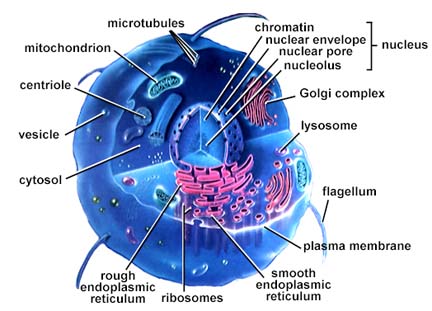
This picture shows what a cell consists of. As you can see by the labels a cell has many different organelles, some with very similar functions. 

Chapter 4 walked the reader through a cell. It started out by stating how a cell can be viewed and studied. From there it went on to talk about the two different types of cells and what difference/similarities they had with each other. A cell has many different organelles all with their functions. Some of the mentioned organelles were the nucleus, ribosomes, ER, golgi apparatus, lysosome, vacuole and peroxisomes. 

Key Terms:
1) Organelles: little organs that perform specific functions for a cell
2) Chromatin: a complex of proteins and DNA
3) Nuclear envelope: a double membrane perforated with protein-lined pores and controls the flow of materials in and out of the nucleus
4) Lysosome: houses digestive enzymes enclosed in a membranous sac
5) Vacuoles: membranous sacs that have a variety of functions
6) Chloroplasts: organelles that photosynthesize and create food for plant cells
7) Cytoskeleton: network of protein fibers that give structure of a cell
8) Integrins: span the membrane and attach the other side to proteins connected to microfilaments of the cytoskeleton
9) Cell wall: distinguishes plant cells from animal cells as well as gives the plant cell more rigidity
10) Flagella: projection that helps propels a prokaryotic cell through a liquid

http://www.youtube.com/watch?v=QGAm6hMysTA

Chapter 3- The Molecules of Cells

Q: How are monosaccharides formed?
A: Monosaccharides are formed when some multiple of CH2O join together to form a carbohydrate.
Q: What is so bad about anabolic steroids?
A: Anabolic steroids are bad because they are a synthetic hormone of testosterone. When anabolic steroids are used by an individual on a regular basis it can stop the natural release of male hormones in the body. Effect of using this drug range from high blood pressure, liver damage to reduced sex drive and infertility.
Q: How strong are peptide bonds?
A: Peptide bonds are covalent chemical bonds between a carboxyl ground and amino group. This are very strong bonds since they are covalent.

Five main facts
1) Proteins can be found in all structures of life and are necessary to the functions of life.
2) There are four structures of protein, primary, secondary, tertiary, and quaternary.
3) Lactose tolerance is only a new event in human history. In the last 9,000 years since cattle has been domesticated anyone with the lactose tolerant gene was favored and hence survived better then those who didn't have it.
4) There are six functional groups, hydroxyls, carbonyls, carboxyls, aminos, phosphates, and methyl groups.
5) Organic compounds must have carbon present in the structure.
This diagram shows one way of depicting the structure of a molecule. This specific depiction of a molecule is called a ball-and-stick model. The four white balls are hydrogen and the center black ball is a carbon atom.

Chapter 3 was an overview of what cells are made up of in terms of molecules. All living organisms and other organic compounds contain carbon. This is what constitutes an organic compound. The structures of compounds were discussed and how they affect different functional groups in terms of being either a monosaccharide or a polysaccharide. There are many different structures, molecules, atoms, groups that are present in a cell. They are all necessary for a cells function.

Key Terms:
1) Organic compound: any compound containing carbon
2) Carbon skeleton: chain of carbon atoms in an organic molecule
3) Functional group: first five chemical groups
4) Macromolecules: molecules that are large in comparison to the majority of other molecules
5) Monomers: building blocks of polymers
6) Hydrolysis: the breaking of bonds by using water and adding it to the monomer
7) Saturated: fats with the maximum number of hydrogens
8) Protein: a polymer constructed from amino acid monomers
9) Denaturation: polypeptide chains unravel, losing their specific shape as well as their function
10) Primary structure: structure of a protein with a unique sequence of amino acids

http://www.youtube.com/watch?v=SYNwuLL_pOE

Tuesday, September 14, 2010

Chapter 2- The Chemical Basis of Life

Q: What are the four main chemicals that are present in living matter?
A: The four main chemicals that can be found in all living matter/organisms are oxygen, carbon, hydrogen, and nitrogen.
Q: What is a trace element and how do they benefit humans?
A: Trace elements are elements that are needed by all living organisms. Trace elements are often added to certain foods such as cereal to increase the nutritional value of the food for health purposes.
Q: How is it that radioactive elements are be beneficial to humans?
A: Radioactive elements can be beneficial in the sense that they can help prevent as well as diagnose certain diseases or health issues that one may encounter. In small dosages, these elements will not harm the human body and with help make it healthier. For example using radioactive treatment in order to kill off cancerous cells. In high dosages this can prove to be fatal or cause mutations and other health issues.

Five main facts:
1) All living organisms are composed of about 25 chemical elements. There are some other elements that may be found in certain forms of life but these consist of the main elements.
2) Radioactive tracers are used by medical experts in order to help diagnose patients with certain ailments.
3) Covalent bonds are a strong chemical bond in which two atoms share electrons.
4) Ice is less dense then water because when water freezes it forms into a crystal and the bonds between the water molecules are all at equal distances from each other.
5) Buffers are biological fluids that help minimize the changes in pH.

This photo depicts how water molecules are arranged when it freezes. As shown, there is an equal distance between all of the hydrogen bonds and they appear of be very stable. 

When reading this chapter, it introduced to the reader that before studying biology, one must understand what life is made up of. All living organisms are made up of elements which can be broken down to atoms wich can be broken down into subatomic particles. Chemical bonding is how certain elements are able to join up with each other and why they are able to do this. This chapter also alluded as to why water is able to support so much life. The pH scale states how things are measured in terms of acidity. 

Key Terms:
1) Matter: anything that occupies space and has mass
2) Element: a substance that cannot be broken down to other substances by ordinary chemical means
3) Compound: substance consisting of two or more different elements combined in a fixed ratio
4) Proton: a subatomic particle with a single positive electrical charge
5) Electron: a subatomic particle with a single negative electrical charge
6) Neutron: a subatomic particle with  neutral electrical charge
7) Molecule: two or more atoms held together by covalent bonds 
8) Heat: amount of energy associated with the movement of atoms and molecules in a body of matter
9) pH scale: describe how acidic or basic a solution is
10) Chemical reaction: making and breaking of chemical bonds, leading to changes in the composition of matter

http://www.youtube.com/watch?v=M8tTELZD5Ek

Thursday, September 9, 2010

Chapter 1-Biology: Exploring Life

Q: How is it that ecosystems are so efficient?
A: Ecosystems are efficient because ever aspect of the environment is put into play. Also the multitude of organisms that inhabit each ecosystem play a major role in the efficiency aspect. Rocks are broken down by roots of trees and other plants which allow for more fertile soil and denser vegetation. Even when animals die they are recycled back into the earth. Ecosystems are efficient because they are a constant cycle that are very difficult to break.
Q: Why do scientists break down things into specific categories?
A: Scientists use categories in order to organize and keep track of organisms as well as their interactions within the biosphere. Scientists do this in many different ways. They use categories to breakdown how organisms interact with one another as well as the different types of organisms that there are throughout the world.
Q: How effective are experiments?
A: When experiments are done in a proper manor they can be quite effective and allow for a multitude of questions to be answered. This allows for scientists to come to even more conclusions and possibly even form new hypothesis' that can be tested.

Five Facts:
1) DNA is the blueprint that allows for life to happen.
2) There are two types of cells, prokaryotic and eukaryotic.
3) There are seven properties that all organisms posses, order, regulation, growth and development, energy processing, response to the environment, reproduction, evolutionary adaptation.
4) There are three main domains, bacteria, archaea, and eukarya. These three domains include all living organisms.
5) Evolution is in our everyday lives. We are constantly surrounded by it and can be reminded of it simply by looking at people of a different nationality or the different types of birds we see on a daily basis.
This diagram shows the difference between a prokaryotic and eukaryotic cell. As this diagram clearly shows, a prokaryotic cell is much smaller and less complex then a eukaryotic cell. Prokaryotic cells have fewer organelles and are commonly referred to as bacteria. 

Chapter Summary:
Chapter 1 introduced to the reader the basic concept and idea of biology. Within the hierarchy of life, the interactions of the steps of life allow for more properties to be revealed. Cells are the basis for all life to exist and this can be broken down into atoms and DNA that hold the genetic blueprint for all life. There are three domains in which all life can be put into, Bacteria, Archaea, and Eukarya. Thanks to Darwins theory of evolution, the idea of natural selection has opened the eyes to many scientists who study taxonomy. This chapter also explained how evolution is within society and everyday life. 

http://www.youtube.com/watch?v=4N_V6FdB3qQ

Terms:
1) Biosphere: consists of all the environments on Earth
2) Consumers: organisms that eat plants and other animals
3) Emergent properties: new properties that emerge with each step upward in the hierarchy of life, owing   to the arrangement and interactions of parts as complexity increases
4) Prokaryotic cell: much simpler and usually much smaller then a eukaryotic cell
5) Domains: three kingdoms of life that biologists have agreed upon
6) Natural selection: survival of the fittest
7) Theory: an explanation of a much broader scope 
8) Ecosystem: consists of all the organisms living in a particular area
9) Molecule: cluster of atoms held together by chemical bonds
10) Genes: units of inheritance that transmit information from parents to offspring